A Splitting Headache
Back to the game.

Last time, we'd solved the "maze" of the wetlands and arrived on the far shore. Heading north from here lets us see more:

You're on the high shoreline of a lake. To the east is a barbed wire fence through which you can see mile after mile of plain houses, all the same. A path travels to the north and south, bordering the fence and the water. To the west, the lake looks treacherous as a waterfall crashes down to the south.
Ennio hugs the shoreline, staying as clear of the wire fence as possible.
:LOOK HOUSES
They're too far away to make out in any great detail from here, but the place has a very weird feel to it.
We've been torn to shreds by more horrific monsters than we can count, and we outwitted a deadly sentry who was a giant nose with legs, but yes, cartoon suburbia is definitely the
truly uncanny thing. Further north...

You're at the entrance of Ennui Estates. Beyond, to the east, you can see what could only be millions of identical picket fences surrounding identical white clapboard houses. To the west is the lake and a small landing. A small rowboat is moored there.
This is clearly important and not the edge of the map. It's also the place Nuyu accuses us of showing up from if we aren't dressed to his satisfaction.
:E
You manage to climb the fence, scratching yourself badly. You wander aimlessly through the streets of the Estates, and find nothing.
The named objects here aren't much more helpful:
:LOOK BOAT
It's just a rowboat.
:LOOK FENCE
It's a barbed wire fence.
But the boat will let us get onto the lake without feeding ourselves to the Allidile.
:ENTER BOAT
Ennio hops into the boat right behind you.
:W
You're floating in the boat. The current to the north seems to push you to the south a bit.
To the south, a waterfall roars as millions of gallons of water pound a hundred meters below.

I'm
really curious how the lake here retains what water it has. The description here is also a bit misleading, describing the waterfall as to our south as if we shouldn't go that way. The other directions don't help us:
:W
You try to make it to shore but cannot find a place to safely dock amid the ruined and boulder-strewn shore.
:N
The current is too strong to fight. You manage only to hold your position.
The only way is south, which gives us the same image, but adds a water-rushing sound effect and, interestingly,
doesn't describe the waterfall:
:S
You're floating in the boat. The current to the north seems to push you to the south a bit.
Going south from here is a bad idea.
:S
You go quickly and easily over the waterfall to your death.
This is fair play. If we were making a map we're guaranteed to have the waterfall room on it already. The remaining open space is to the west, so that's the way to go. We get a new graphic here, too.

:W
You're on a section of the lake directly south of a landing for the Island of the Tower. The current to the west is rather strong.
:W
The current is too strong to fight. You manage only to hold your position.
:S
You can't go in that direction!
This is a little wacky, but it
does track our map: the wetlands only had a waterfall on one screen, and otherwise we were just blocked. The only way to go is north.

:N
Before you lies the entrance to the Tower. To the east and west is a heavily boudered area. Your boat is moored to the south.
:LOOK TOWER
You see nothing special.
I dunno, that tower looks pretty great to me. Look at that random tetrahedron cutting through it.

Once again, this is a pretty linear path. Nowhere to go but north, then west.

:N
You're inside a chrome, glass and steel office complex, an antiseptic and empty tower. An elevator sits off to the west, its door open.
:W
You're in a small elevator. Before you are four buttons, mounted on a plaque. There is a slot beside a top, fifth button.
:LOOK BUTTON 5
You see nothing special.

There's a lot of places where the game leans on the illustrations to carry the gameplay over the text, but I think this might be the only place where the text's thin implementation is actively misleading. There is something
very important we see on button 5; it's got the same insignia as Snarl's keycard. That is very clearly where we need to go, but if we want to be stubborn, we can go to floors 2-4 instead. All of them are the same:

:PUSH BUTTON 4
You feel a slight movement as the elevator starts and then stops again.
:E
You're in an east and west hallway of office doors, each of which look exactly alike.
:E
You're in an east and west hallway of office doors, each of which look exactly alike.
:OPEN DOOR
A guard suddenly appears as if from nowhere. "You don't belong here." Before you can do anything, he escorts you down the elevator, to your boat, and then to the shoreline.
This punts us all the way back to Ennui Estates. The infinite hallway isn't just a loop, though; it actually counts how many times you've walked down the hall and it demands you walk just as many steps back. Presumably something wraps around or counter-stops after 255 or 65,535 steps, thanks to 8- or 16-bit counters, but I frankly can't be bothered to check.
Now to do the obviously correct thing.
:PUT CARD IN SLOT
You insert the card into the slot.
:PUSH BUTTON 5
You feel a slight movement as the elevator starts and then stops again.
:E
"Great to see you, Whippasnappa! Get these cuffs off of me!" Gramps says.
You are in a vast penthouse.
Ennio sits by Gramps' feet and yaps, "Alright, old timer. Lets bolt outta here!"

OPEN CUFFS just tells us "You can't open the cuffs." But remember what the Daglets told us? They couldn't play a concert here because their Zagtones would "damage the equipment." Sure enough...
:LOOK CUFFS
They look like hand and ankle cuffs but don't seem to have a keyhole. There's a little label on their sides.
:LOOK LABEL
You see nothing special.
God
damn it, parser.
:READ LABEL
The label reads: "SONIC LOCK LTD."
:HIT CUFFS WITH ZAGTONE
The cuffs spring open!
You are in a vast penthouse.
Ennio paces around nervously. "We gonna jam out of here or what?"

We can get some backstory here before we move on.
:GRAMPS TELL ME ABOUT ENNIO
"He's my dog, and that should say it all!"
:GRAMPS TELL ME ABOUT SNARL
"He's warping time and space with his twisted hoop, we gotta stop him."
Not
much backstory, though. Returning to the boat is simple enough; we just retrace our steps. As we leave the tower...
Gramps motions towards the boat and yells, "Come on! Time's a wastin'! That Snarly thing is goin ta upset the whole space-time continuim if'n we don't get to his lab soon!"
:ENTER BOAT
Ennio hops into the boat right behind you. Gramps slides into the boat, too.
With Gramps helping us rowing, now we
can beat the current to the west.
:W
You fight your way across the current to the west and manage to land the small boat.
You, Gramps, and Ennio leap to shore.
Before you can tie up the boat, the current pulls it out into the lake, far out of reach.

Yeah, this sequence is pretty heavily scripted. But what if instead we tried to go the
other way, to the current to the north of the landing?
Well,
fuck you is what happens. We're on rails, baby!
Gramps shakes his head and grabs the oars and, with all his strength, rows west until he lands the boat. "Sorry about that," he says, "but I've got something important to do. If you want to help, I'd like that."
Either way, we're back on the mainland and the endgame is live. This has changed a few things about the map. We could, for instance, decide to go confront Snarl in his pet shop, but going west from the town square now tells us this instead:
You try to enter the pet store and notice a sign on the door. It reads, "Closed."
Well, if he's not in the pet store, he's in the well, right? I left the black mask in Ennio's office, so we'll have to go pick that up before we go after him. Along the way, we can talk to Nuyu:
"Franklin Snarl is still on the loose.", shouts Nuyu.
The punctuation there isn't me being sloppy, alas:

Returning to the well and going down, we die instantly.
Ennio hops onto your back, and you grab the handholds and slowly step downward, rung by run, into the inky blackness.
Mad creatures have been released in the well, they see you...
It seems that the game has ended. Would you like to try again?
This, shockingly, is
almost fair play. We've already seen everything we need to piece the situation together, and if we'd been more suicidally reckless, we'd even have a smoking gun.
Clue 1: Snarl knows that we're up to shit. Way back in Update 2, the first time we got into the pet store without getting tortured to death, we noticed a bit of scenery with an actual description.

... there is a small sign near the register on the wall. ...
:READ SIGN
The sign reads, "Sonic Lock Alarm."
There is a small, unlit red light next to it.
Gramps's cuffs were marked "SONIC LOCK LTD." If the pet shop were still accessible here so that we could
actually see the alarm blinking or something, I'd have to call this
completely fair play, because...
Clue 2: We know what Snarl's emergency protocols are. Once we got our mask and got past the Philbert, we found a button.

We traced the wires to the monster cages in the other room, and we also (in a playthrough we didn't keep) tried pushing the button, which dropped steel bars behind us and let all the monsters in the Philbert room out into the area at the bottom of the well.
That button also had a plaque under it, and we checked it at the time.
:READ PLAQUE
The plaque reads: "Emergency only -- FS."
A note to self from Franklin Snarl.
Clue 3: We can make this death message happen entirely on our own. On the playthrough where we pushed the button, we ended up in an unwinnable situation, because the sentries were still active and they guarded the only path out. If we had instead defeated the sentries
first, then gone through the well, pushed the button, and left through the now-safe front gate, but then
also gone back into the well we just filled with monsters, we'd die instantly with exactly the message we just got.
Fortunately for us, we actually already unlocked the gate, so we can just waltz directly in the front door instead of bothering with any of this.

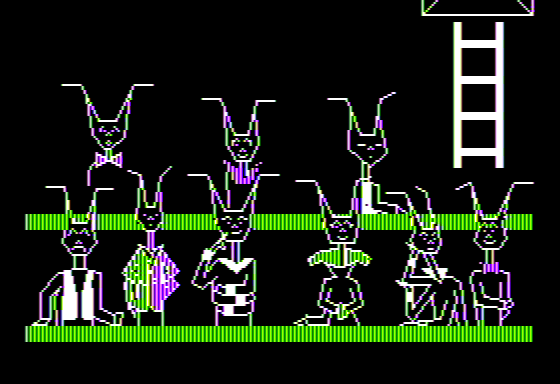
We've seen these guys several times already but I'm taking another screenshot because they're just that great.
Beyond the gate, there's a few rooms we missed the first time we were here.

You're at the northern lawn of Snarl's estate. Way off to the north is a steep cliff going straight down, while the east is bordered by a brick wall.
Despite being "way off to the north", entering NORTH here kills us immediately with the message we needed to explicitly JUMP OFF CLIFF for in the other rooms like it. The room to the west is more honest.

You're on Franklin Snarl's estate, on a vast expans of lawn. To the north lies a steep dropoff.
"I don't hear much to the north. Last I remember, there was a cliff out there. Stay close," Ennio counsels.
Yeah, uh, I don't think we need to rely on hearsay for this one, Ennio, buddy.
We really need to go to the middle of the lawn.
"Be very very careful, now. That Snarl is an extremely tough cookie!" Gramps warns. "You said it, buster!" Ennio says.
You're in the middle of Snarl's huge estate. Lawn surrounds you on all sides but the west. To the west is a wing of Snarl's house.

South of here is the entrance to the tunnel, chill Jawdawg and all. If we actually head down into the tunnel, we can even confirm that the button's been pressed and the steel doors are shut. That's not what we're here for, though. We're here to invade Snarl's inner sanctum.
Before we do that though, I'd like to take a moment to appreciate just how much mileage they got out of three colors when drawing the lawn here. Seriously, check that lawn out.
:W
You're in the house of Franklin Snarl. The place smells of old things, best left unnamed. Even in your light the place seems dim and dingy. You can hear crackling coming through the doorway to your north.
Ennio says, "I smell Snarlmeat!"
This is a good time to quicksave. It's also not a terrible time to pump Gramps for everything he has to say about whatever objects we can think of. There are two interesting results here, which will help us past the remaining obstacles:
:GRAMPS TELL ME ABOUT MUSHROOM
"They're like bags of rosin dust! Unreal!
:GRAMPS TELL ME ABOUT DEVIL
"They're shocking things to run into. We might be able to use one against Frankl
in Snarl. Yeah, that's the ticket."

Now we can head north, to the final confrontation! Normally, when Ennio gave that warning, proceeding onward would spell instant death for us. However,
this time we have a secret weapon: a higher priority target.

Franklin Snarl attacks Gramps, and they roll about on the floor of the lab. It looks bad for Gramps.
You're in the laboratory belonging to Franklin Snarl. It looks oddly similar to the lab in Gramps's house, though it's a much smaller version. A hoop buzzes and crackles in the corner.
Franklin Snarl is here!
Ennio growls at Snarl.
Nuyu told us what to do here.
:SIC ENNIO ON SNARL
Ennio corners Snarl and growls like a fighting tiger, holding him at bay. You now know that the legend of Ennio was well-founded -- he is fearless!
"Gimme my lab book, youngster!" Gramps shouts. "I need something from the first few pages."
Oh, you thought the guitar picks were the only thing that would instantly make the game unwinnable if you left the first area without them? Alas, it is not so.
That also said, wasn't the legend of Ennio that he was a superior journalist or something?
:GIVE BOOK TO GRAMPS
Gramps grabs the book and immediately sets to fixing the hoop. In a few short seconds, he's done!
"Let's get that Snarlburger through the hoop! And fast!"
Well, you heard the man.

Yeah, that doesn't work, but Gramps had a suggestion earlier, didn't he?
:OPEN JAR
Since Ennio has him cornered, the lightning seems to home in on him and stuns the creature.
Doing this before siccing Ennio on him is
also a bad idea.
The Snarl dodges about and the lightning spins around and strikes you and Gramps. The next thing you know, you awaken dead.
This sequence is pretty rude, in my opinion. Gramps tells about it, but he has to be
explicitly prompted to do so, and it's just as easy to attempt to use the mushrooms or the devil as a weapon as it is to ask about it in the first place. A player that never found the jar—or who never found the Devils at all—would simply find themselves here and simply getting overpowered no matter how they proceeded. They won't even be pointed to the fact that it's an
item that they're missing.
We're fine, though, and we can even confront Snarl before proceeding:
:TALK TO SNARL
The Snarl weeps a large tear, "You don't understand! I was Gramps's greatest creation! He took me through the hoop when I was many small animals, making me an utterly new creature, unique in all the universe. You can't destroy me now! I've just begun his work here, making new creatures with the hoop!"
Hang on a second. Wasn't there a whole thing at the beginning about anchovy pizza causing nightmares and then sleeping with the hoop turned on was somehow going to damage Tonetown? Now he's the result of some completely unrelated experiment?
I suppose he
could just be lying. Crocodile tears are famously unpersuasive, after all. Still, Gramps had the right idea...
:THROW SNARL THROUGH HOOP
You manage to push Franklin Snarl through the hoop! A great sizzling, as if bacon frying, accompanies his passing through to the other side.
You and Gramps wave to each other and you bend down to pat Ennio's head.
"So long, Whippasnappa," Gramps shouts, waving to you. "You keep the cabin and come visit me soon. I'll be right heyah in Tonetown, waitin'!"
... is it unfair to note that Gramps has like four lines this update and he seems to have a different accent for each one?
And with that, everything twists and turns -- your knees buckle and you find yourself on the road a mile or so north of Gramps's cabin. Sitting by the side of the road is a cute little pig, a darling raccoon, and a little crocodile shedding a few tears.

... on the other hand, this seems like pretty persuasive evidence that the pizza had nothing to do with it, and also it only shows up as an optional command immediately before winning the game. What are we even doing here?
It seems that the game has ended. Would you like to try again? (Y/N)
No, actually, I think we're good.
Beating the Game
This game was not considered difficult in reviews at the time, and even some of the folks who played it as kids either cleared it or got pretty far in. This make sense; the game is pretty rude, but it's also
short, especially if you're beelining progress. Here's the final TODO list for everything on the critical path:
- Get to Tonetown. This simply requires you to unlock the lab door with the key in the cookie jar. If you enter Tonetown without both the picks and the book, the game is permanently unwinnable.
- Stop getting murdered by the locals. You need picks from the (now unreachable) first area of the game in order to buy a makeover.
- Get a light source. Burgers are a temporary light source and require you to have the mitts equipped for as long as the burger is in your inventory. A Red Devil in a jar is a more permanent solution, and only requires the mitts to be equipped on the turn you capture it. The jar itself requires searching to acquire but it's otherwise "free."
- Defeat Snarl's security. This requires a light source and the black mask from Flo's. Defeating the sentinels requires a mushroom, but mushrooms are almost literally everywhere outside of town and you don't have to barge past the sentinels just to unlock the gate.
- Rescue Gramps. This requires the Zagtone (which requires the press pass, which requires the makeover) and the debossed metal card (which requires a blobpet).
- Defeat Franklin Snarl. This hard-requires rescuing Gramps and also having a Red Devil in a jar and the
sandalwood box book from the opening area. It soft-requires knowing the command SIC ENNIO ON SNARL, which requires the picture of the Daglets to cue, which requires the camera, which requires the makeover.
That's not a
whole lot, but we still have several fairly gross ways to make the game unwinnable. Not counting boring ones like "there's a countdown to your death happening and you've dawdled too long", the three big ones are "leaving something critical in the initial cabin," "not realizing you can, and must, take a Zagtone while interviewing the Daglets," and "rescuing Gramps too soon." The book is rude in that missing it obliges you to replay the entire game—you make the game unwinnable at turn 10 and then aren't told this until two commands before winning the game—but it's really the Zagtone that's the rudest one here. You only get one shot to talk to the Daglets, and the in-game hint that Zagtone sounds wreck tech in the Tower is both pretty oblique and doesn't suggest in any way that there's a Zagtone in the room free for the taking.
It's even worse than that, really, because unlike every other takable object in the game it does not
actually have an illustrated icon in the room where you can take it! DAGLETS TELL ME ABOUT ZAGTONE gives the default reply they give to any other case where you asked about an unimplemented object. It is
extremely likely that a player that gets stuck here will be generally aware that they are stuck but have no idea where to begin—poring over the transcript won't even help because there's no fatal move to be undone, no indication of what the crucial object is, and
explicit text from the game engine itself suggesting that the object is only scenery and doesn't really exist!
Even for 1986, I think that's a little shoddy.
Beating Up the Game
Back at the start I suggested that we could summarize the game by saying that for a text adventure, it had really impressive graphics. If anything, replaying it here has underlined that for me. 1986 was a
completely bonkers year for video games in the console world, with
The Legend of Zelda,
Metroid,
Castlevania, and
Dragon Quest all landing on the NES alone, and the Atari 2600 getting my beloved
Solaris. But if you look at those, and then you look at, well, all this, there's really no comparing them. The IIgs couldn't do the things the game machines could, but nothing there looked like this, either.
The game engine, meanwhile, is... passable. This is a far cry from Infocom's parser tech, but Infocom (who released
Trinity this year too) was the best in the business at parser tech and it wasn't close. Beyond them, the state of the art was
Uninvited on one side, and
Ultima IV and
Might and Magic I on the other. Nothing here is great, but people were getting away with worse years later.
But everything else about this is just bizarrely slapdash. The text quality in particular is a
disaster, and while I've been occasionally calling out the more unfortunate writing choices, much more basic stuff like "not having comma splices" and "correctly punctuating dialogue" scream off the page. The overall coherence of the writing also suffers: characters directly on the critical path have dialogue that talks about how their preferred role was cut from the game, the opening and ending have nothing to do with one another, characters will refer to events that didn't necessarily happen, or will describe something happening again as if it were for the first time. That leads into the weakness in much of the game's overall design
as a game—very few items, including game-critical ones, implement any actions beyond the bare minimum to serve their role as a puzzle solution. Almost nothing in the game rewards further examination. Critical game state can change with no way of interrogating it beyond "quicksave and see what happens". Crucial clues appear only in death messages or after the puzzle itself is solved. Most baffling to me, though, is that the Berlyns were
ex-Infocom and also
were both English professors at Harvard. The text and design here just have
no excuse to be as ragged as they are.
Now, it's possible I'm being too harsh here; most of the, for lack of a better word, literary theory that I'm using to critique the design here wasn't seriously formalized until the turn of the century, long after the initial wave of designers had left the genre. And while
Trinity may have come out the same year, and while modern players hold it in far higher esteem, it won't hold up to the kind of scrutiny I'm applying here either. And none of this seems to have hurt its reception any; Trinity wound up reviewing slightly better, but the two Infocom games
after it seem to have fared worse.
All in all, it did what it came to do, and it did it effectively enough. And on the IIgs, it managed to do it
first while still being this good, which I do in fact still salute.
That leaves only one remaining question, here at the end:

Who's a good dog?


 I guess we would like to try again.


 The little smiley face at the end is also a nice touch. (Yeah, it's just the cursor, but still.) Fortunately, this is what quicksaves are for; let's go east now.


 Can you afford not having it? It's not safe out there, you know.
 Having read through the source code, this is actually kind of funny; their underlying engine doesn't have an inventory limit, but it does have a weight limit. They just gave every item in this game a weight of 1, so they never have to worry about overdrawing the inventory window.)

 Now just one moment there, mister.


 tass_4_15_om_nom_nom


 )
)


 Foreshadowing?


 Maybe Ennio can explain it for us after we reload.


 The nature trail is a bunch of rooms east and west of the park, so we'll have our work cut out for us. On our way back, though...


 I go do a lap around the forest, popping back into Snarl's front yard to just to prove I can (he must really be in the well; nobody noticed), and by the time I get back, he's here again.


