Ultra-Touch and Tass Deluxe: Let's Play Tass Times In Tonetown!

Put your Let's Plays in here.
Post Reply
User avatar
Let's Play Tass Times in Tonetown!

Image

Tass Times in Tonetown is an illustrated text adventure from 1986, simultaneously published on a zillion different platforms, as was the custom of the time.

Was it a good game? Well... the reviews of the time praised its amazing color graphics. It also wasn't really ahead of its time, so a modern game reviewer would find little to praise here and several things to squint suspiciously at. So, no. But we're going to play it anyway.

Why are we playing it, if it's not so great?

A few reasons. One of them is as a healthy tonic against nostalgia. There's something to be said for remembering that the past was not merely full of classics, but also some stuff that was at least good enough to publish and make back what you spent on it. And despite my crack above about the reviews being most positive about the graphics, this came out the same year that The Legend of Zelda did. Look at that dog up there. The reviewers meant it.

I will look briefly at some of the other ports, but I will mostly be playing the Apple IIgs version of the game in this thread. This has the distinction of being the first commercial release for that system, so that also makes it interesting. I think the IIgs port is the best one of all of them, and it's for the platform with no prior art or tradition. The devs knocked one out of the park as the very first batters.

And speaking of the programmers, the credits list for this game is incredible. The main design is by Michael Berlyn and his wife. At the time this game out, Berlyn's most famous game was Infocom's Suspended, a deeply strange and complex game about mentally controlling a pack of robots to save your underground warren, with so much to keep track of that it's almost more sensible to think of it as a board game with a text adventure attached to it. (Alas, the most famous thing Berlyn is known for today is probably Bubsy.) The engine it runs on was written by Brian Fargo, who led Interplay at the time and was also the director for this game. And finally, three of the ports -- including both of the ones I'll be primarily looking at -- were primarily programmed by Rebecca "Burger Becky" Heineman, who was legitimately a legend in her own right, albeit a legend of the "very good at what she did, and everyone who knew her was glad to know her" variety rather than the "celebrity" kind. Overall, then, this is interesting because even if it's kind of mediocre, we get to see what comes out when a team of Very Major Players come together and get something shipped that will keep the lights on.

OK, but why are we playing it now?

Rebecca Heineman passed away last year. She was one of Interplay's founders and her credits list range from The Bard's Tale and Wasteland through Tiny Tina's Assault on Dragon Keep, and frankly I can't do justice to her career or to the sheer scope of the shadow she cast along the way. But that means that interesting things can follow in her wake; a few weeks ago her estate discovered her old source code disks for the ports of Tonetown she'd done, they were imaged at KansasFest 2026, and were then posted to the Internet Archive. With those, and a bit of data mining, I now think I can at least do this game justice.

"Tass?" "Tone?" What kind of zorking unheamy dapes are these?

Tophth your jets, gostak. We'll work it out. Like I said, this game is pretty by-the-numbers, so if you find yourself asking if its doing something revolutionary, just figure the answer is "no" unless we end up with a reason to believe otherwise.

But remember: just because it isn't revolutionary or particularly important doesn't mean it wasn't competent. This is a game you wouldn't regret playing, but overall I don't think it's a game you'd go out of your way to play, either.

And isn't that what Let's Play is all about? Let's go have ourselves a time.
Last edited by ManxomeBromide on Fri Aug 28, 2026 3:04 am, edited 5 times in total.

User avatar
Reserved for future probably-not-nefarious purposes

User avatar
Departure

We begin in the middle of things, or in the kind of "the middle of things" that is traditional for text adventures:

Image
This is your grandfather's main living area in a secluded, winterized log cabin, deep in the northern woods. The dining table has an order slip from the local pizzeria.
Spot is here, lying on the floor.
As you can see, we're prompted to scroll down if there's more text in one wodge than fits in the little area at the bottom. Once we're done we get our normal input, with a cute little happy face for a cursor:

Image

We don't always have to type commands, either; clicking on a part of the illustration will sometimes do something sensible with it, and then we've got a weird sort of command-wheel there in the upper right, with TAKE, TALK TO, DROP, BUY, HIT, TELL ME ABOUT, LOOK, and ENTER, and a compass rose for navigation. These just fill text into the command region, though, so I'll be ignoring the mouse for the duration here.

Speaking of ignoring the mouse, if we press ENTER without actually giving a command, we swap between illustrated mode and text mode:

Image

It can take upwards of a second to update the illustration, so if we've got a lot of navigation to do, or if we got ourselves murdered and need to quickly replay a bunch, text mode is the way to do it.

Presumably we aren't going to get murdered here, though. Instead, there is a dog. Time to put this game to the harshest of tests:
:LOOK SPOT
Spot's name, oddly enough, comes from the spot on his back.
:PET SPOT
He would purr if he could but he can't.
:TALK TO SPOT
Spot wags his tail and smiles.
Test passed. The manual doesn't actually tell us what we're supposed to be doing in this game, mind you, and the game hasn't seen fit to suggest anything either. 1986 is early enough that it's reasonable to expect the player to meet you half way and just mess around in the environment you dump them in. They weren't actually that careless, though; the player will have read the back of the box and knows that your grandfather has gone missing and that the point of the game is to find him, and the game's feelies include a newspaper from Tonetown itself that make it clear that "Gramps" is known to them as well and that he's gone missing.

They also, uh, didn't trust the player very much because the manual and the back cover copy basically tell you most of what you'll need to do to solve the entire first half of the game but without openly treating it as hints. I'll be ignoring those until we actually get to the point where they don't spoil the LP.

Anyway, here we are, bold adventurers, presumably summoned to visit Gramps and have arriving to find he's not here. Time to get adventuring, and by "adventuring" I mean "taking everything we can and looking at everything we can't."
:LOOK TABLE
There's an order slip on it.
:READ SLIP
You can't help but notice that the anchovy and pepperoni combo has been circled. It's gramps' favorite, but always gives him terrible nightmares.
:GET SLIP
Who needs a greasy order slip!
:W
Image
You're in a hallway off the living area. A bedroom is to the south, while the lab door is off to the north.
:N
You try the door, but it's locked.
Aha! A tangible goal! But first, a bedroom to the south.

Image
:S
You're in a messy bedroom. Gramps was never the best housekeeper, even though he keeps a spotless laboratory.
Spot sits by the foot of the bed whining softly.
:LOOK BED
The bed hasn't been slept in for a day or two.
:LOOK CLOSET
It appears as if all his clothes are still here.
:LOOK DRAWERS
Tsk Tsk! Where is your mind?
It's bent to the task of looking for clues, game. There absolutely could be clues hiding in the sock drawer. At least we have reason to believe that Gramps' disappearance is recent.

Incidentally, despite the graphical compass rose, it doesn't indicate exits, and as you've seen, the text itself is a little casual about actually telling us where exits are. Playthroughs are going to include a lot of this:
:S
Into the wall?
:E
Into the wall?
:W
Into the wall?
That said, we didn't check the first room as carefully as we should have, because we missed a spot. Let's just head back there, and...
:N
You're in a hallway off the living area. A bedroom is to the south, while the lab door is off to the north.
:E
This is your grandfather's main living area in a secluded, winterized log cabin, deep in the northern woods. The dining table has an order slip from the local pizzeria.
:S
Image
You're in a small, familiar kitchen.
Spot is here, barking at the kitchen counter.
On the Apple IIgs version we actually get a little "Woof, woof" sound clip that plays after every command we type.

What is it, Spot? Did Gramps fall in the well?
:LOOK COUNTER
Sitting on the counter is an odd-looking cookie jar.
:LOOK JAR
There's a key in the jar!
"Obvious objects" get drawn front and center in the screen.

Image
:LOOK KEY
It's a metal key.
:GET KEY
You got a key.
You're in a small, familiar kitchen.
:LOOK SINK
Adventurous souls aren't stuck in the kitchen.
Hey, maybe adventurous souls just want a snack!
: DRINK WATER
Aaah! Tastes just like the water grandma used to make.
One of the things that got me to do this LP was the ability to datamine the files more easily thanks to the source code release. This got me, among other things, the complete verb list.

The last entry in the verb list is "BURGER." Well, we are in the kitchen. Maybe we can do better than just water.
:BURGER
Death and disfigurement for all who chant the unholy word. A blood-stained axe lops down and leaves you headless.
It seems that the game has ended. Would you like to try again? (Y/N)
Image

Wow, rude. :black101: :stonk: I guess we would like to try again.
This is your grandfather's main living area in a secluded, winterized log cabin, deep in the northern woods. The dining table has an order slip from the local pizzeria.
Spot is here, lying on the floor.
Right. Fine. SOUTH, LOOK JAR, GET KEY, NORTH, WEST.
You're in a hallway off the living area. A bedroom is to the south, while the lab door is off to the north.
:N
You try the door, but it's locked.
:UNLOCK DOOR
You open the door and rush inside.
I know we can't all be Hadean Lands, but I really do miss doors that unlock themselves when you hold the key.

Image
You're in Gramps's lab. It looks like it could use a good dusting. There is a half-eaten pizza and a fishbowl sitting on the lab bench.
You see a book.
OK, we're definitely about to get in trouble. Let's do what we should have done earlier.
:QUICKSAVE
Your game is saved.
:LOOK PIZZA
It looks mighty old.
... sure, I guess we did just save. That means we can do unwise things with impunity.
:EAT PIZZA
It's cold,slimy and rather repulsive but you manage to gag some down. You wish you hadn't.
This actually doesn't kill you or anything, but if we wish we hadn't, we can make that happen't!
:QUICKLOAD
We get more distinct load/save options as well, but the quickload/quicksave system is handy for when we're messing around.
:READ BOOK
The book is opened to a page whose date is just a few days ago. It says, "Shouldn't have had the pizza. Fell asleep with hoop on. Fear the worst. Grabbing some picks for barter. Am going thru to examine pizza-nightmare damages. Rips in space are feared to be...." Except for the first part of the book, encrypted with arcane symbols and mathematics, that's all you can make out.
As a Doomed Apocalypse Log, this leaves a bit something to be desired, but at least we've got a bunch of stuff to take here.
:GET BOOK
You got a book.
You're in Gramps's lab. It looks like it could use a good dusting. There is a half-eaten pizza and a fishbowl sitting on the lab bench.
:SEARCH FISHBOWL
A bunch of guitar picks sit in an otherwise empty fishbowl.
"Grabbing some picks for barter," he says in the journal. Presumably he means these. The Tonetown Times actually references this too; one of the articles discusses a town meeting where they decide to continue using "p" as their currency instead of switching to floppy disks. Well, we can grab some too.
:GET PICKS
You got a bunch of guitar picks.
You're in Gramps's lab. It looks like it could use a good dusting. There is a half-eaten pizza and a fishbowl sitting on the lab bench.
:I
You have a book, a key, and a bunch of guitar picks.
# of guitar picks: 50.
As you can see, the inventory actually tracks the number of picks we have, and it will update it as we buy things throughout the game. This is the most mysterious thing in the game; there's a bunch of game logic tracking all our purchases, and this is the only place in the game we can get money. You'd expect that this means we'll have to carefully marshal our funds and ensure that we only buy the things we'll need to beat the game, maybe needing to restart due to unwise budgeting or something. But no. 50 picks is ludicrous overkill; it's technically possible for us to run out, but we have to intentionally bankrupt ourselves to do so. To the extent that there's a puzzle here, it's finding the pick stash in the first place.

The last location in the cabin is to the east of here.

Image
You're in the eastern part of the lab, standing before a silvery hoop which is large enough for you to walk through. A generator is bolted to the floor in the corner.
Spot is here, leaping through the hoop like a circus dog.
Spot is basically Navi in this part of the game.
:LOOK AT GENERATOR
A small plaque reads, "Brainwave Generators. Just throw switch for a jolting experience."
:THROW SWITCH
The generator springs to life and a hum of power pulsates through the mysterious hoop.
Spot leaps up with a glance over his shoulder, lets loose a little yip as he leaps through the hoop in a burst of bright sparks!
Well, if it's good enough for him...
:LOOK HOOP
It's about the size of a hula hoop.
:ENTER HOOP
You get dizzy for a moment, then find yourself in another place.
Next stop: Tonetown. Now that we've fully explored the cabin, though, here's a fun question to tide you over: How the Hell did we get in here? There's no front door in any room.

User avatar
ACAB Includes the Fashion Police

Last time, we turned on a brainwave generator and walked through a mad science hoop into a strange new world where the normal laws of reality do not apply. For example:
:BURGER
What do you want to burger?
:BURGER KEY
You can't burger the key.
Image

Not only do we escape death and disfigurement, "burger" is apparently now a transitive verb.

But we have gotten ahead of ourselves. Where were we, again?
:ENTER HOOP
You get dizzy for a moment, then find yourself in another place.
Oh, right.

Image
You're in a dirt-filled construction site. A trench running north and south starts here. It appears to be dug by unconventional means -- the walls of it are smooth.
You look at Spot and notice he looks radical! He turns to you and says, "say bye to Spot 'n 'Lo to Ennio! I have arrived! Let's blast!" Ennio is following you.
Radical, you say.
:LOOK ENNIO
"I'm a wee dog, wiseguy."
:TALK TO ENNIO
Ennio smiles and wags his tail.
:PET ENNIO
Ennio lets out a little purr.
Despite being informed by the narrator that Spot is both actually named Ennio and also is radical now, this is the only description or illustration we get in-game post-shift. The splash screen at the very start and the box art for the game overall depict Ennio as being still just an ordinary dog, but with a little hat.

I suppose that's enough. Ennio is a Certified Good Dog.

As long as we're here...
:LOOK HOOP
You see Gramps's lab.
:GO THROUGH HOOP
You can't. This hoop is one-way.
Yep, maybe a dozen commands in and we're already at a point of no return. If you didn't pick up something you needed from the first region, you are already screwed. We were pretty thorough, though; I've taken over the key, the book, and the guitar picks, which are the only objects in the region the game will let us take at all.

There's not a lot going on here, though. Let's go exploring.

Image
:E
You're on a north and south sidewalk. To the east is the Jamac Salon, while the construction site is off to the west. Hovering before you is a floatfone.
This seems as good a point as any to reveal why, though I claimed that Ennio was basically this game's Navi, he is much cooler than Navi is:
:ENNIO TELL ME ABOUT FLOATFONE
"You can't dial M for murder or anything like that.
Under basically all circumstances, Ennio only speaks when spoken to. Let's keep heading north down the road for now, sketching out a map of the town before we set ourselves any goals.

Image
:N
You're on a north and south sidewalk. There is a strange bullet-shaped building to the east and a construction site to the west.
Ennio sniffs the breeze like a young puppersnapper.
:N
Image
:N
You're standing in the center of the town square. To the north are beautiful weeping willows, to the west is a pet store, and to the east is an oval shaped building.
Ennio stands beside you, sniffing the stone path. He lets out a little whine.
Sounds like the road ends here? Let's go west and start filling out our map.

Image
:W
Snarl stands up and says, "You're not from around here!" Then he captures you and tortures you to death.
It seems the game has ended. you like to try again? (Y/N)
Wow, rude. :catstare: The little smiley face at the end is also a nice touch. (Yeah, it's just the cursor, but still.) Fortunately, this is what quicksaves are for; let's go east now.

Image
:E
You're standing in the Party Supplies shop, a place for party masks. The woman in charge stands behind the counter.
:LOOK WOMAN
She looks back at you.
:TALK TO WOMAN
"You have to use first names in Tonetown," warns Ennio.
The first-names thing here will come up in a few places over the course of the game. Here, it's really just checking to see if we're paying attention at all.
:TALK TO FLO
"I owned a Flo Rink in this game. Tough break, but the program got too big on the other side. So they says Flo, 'wait for the next game or sell party supplies.' Flo asks ya, what's a girl to do?" She wipes a tear away with a laugh. "Hey, maybe next game."
:FLO TELL ME ABOUT MASKS
"What color mask?"
:LOOK MASKS
They're small masquerade masks.
Mouse controls to the rescue; it lets us distinguish the two masks in the background, though it doesn't tell us anything.
:LOOK GOLD
They're small masquerade masks.
:LOOK BLACK
They're small masquerade masks.
You hear a muttering, faint but annoying: "Stupid tourist."
Screw you, dude, it's not my fault the illustration draws gold as white.
:FLO TELL ME ABOUT GOLD
"What's wrong with it? I like it fine."
:FLO TELL ME ABOUT BLACK
"On you it'd look good. I find the gold one ultratouch."
OK, we'll keep that in mind for later. Let's continue our exploration. South, then east...

Image
The waitress has seated you at a booth and waits to take your order. From where you sit, you can see Fast Freddie's is really hopping. There are dancers whirling around on the dance floor, people eating and chatting at various booths along the walls, while rock music blasts out across the room. There is a small sign on the wall in your booth.
You see mitts.
:LOOK MITTS
They are made of thin silvery material.
:GET MITTS
You got mitts.
:READ SIGN
The sign reads, "Welcom to Fast Freddie's, the hottest place in town! Glo burgers are big, hot, delicious and glowing for only 3p. Activate your brain's neurotransmitters for just 2p with Fast Freddie's Fizzie!"
Well, as long as we're here, might as well mingle.
: DANCE
That was fun!
Franklin Snarl appears muttering, "I hate tourists!" He then grabs you and throws you to the Crocogators.
It seems that the game has ended. Would you like to try again? (Y/N)
Wow, rude.

The modern reviews of this game were kind of jarring to me because they all tend to be of the form "wow, what a cute, quirky place! I wish I could live somewhere like that, or at least visit it regularly," and I do kind of wonder if they, like, noticed that Tonetowners use "tourist" as a slur and if you don't fit in they will not bat an eye as you are plucked directly off a crowded dance floor to be torn apart by wild beasts. We aren't being particularly directly mistreated, at least until we get repeatedly gruesomely murdered, but the feelies are not exactly subtle about the opinions of the populace at large. This is literally the first real puzzle in the game, and it's that our grotesque nonconformity is completely unacceptable to polite society, so we'll need to make ourselves properly presentable if we intend to stay here for any length of time.

Mechanically, what's actually going on here is that a timer starts ticking down as soon as we enter Tonetown, and we hear someone muttering about us at one point and then we get captured and fed to the Crocogators a bit later. It doesn't really care where we are or what we're doing, though if we encounter Franklin Snarl directly while the timer is running, as we did the first time, he just kills us immediately. Or, uh, perhaps at great length. :stonk:

I think I'll be restoring from the save before I went through the hoop just to keep the timer as comfy as possible.
:LOAD GAME
Last game saved was #2. Which game do you want? (0-9)
The "Load Game" and "Save Game" menus at the tops of these screens also let us just pick slots directly. It's a little weird to have slots instead of named saves, but I guess it's mouse-friendlier.

This time we go east twice from our entry point.

Image
You are sitting in a chair in the Jamac Salon. Off to the east you see a rack of brightly colored clothes through a doorway. Chaz, Tonetown's famous BodyStylist, hands you a dyecut dyeorama.
:READ DYEORAMA
You can't read the dyeorama.
Tsk. Sloppy.
:LOOK AT DYEORAMA
It reads, "Pink - 2p; Glitter - 3p; Royal Blue - 4p; Sparkle Plenty - 5p; Feather foil - 10p."
:BUY BLUE
Chaz puts a wild streak of Royal Blue in your hair and says, "Now you're looking tone! Better than that Jonboi Waltune look you had! Let's jet back to the 'Tique."
:E
You are standing in a clothing boutique.
Jonboi Waltune is someone who, according to the newspaper feelie that came with the game, was recently legislatively exiled from town for his continued refusal to meet their standards of dress and appearance. I don't think they actually intended Tonetown to be a vicious satire of how people who make nonconformity their main source of identity ultimately go horrifically toxic, but it's kind of hard to ignore here in 2026. I promise I won't be spending the whole LP complaining about this, but I won't be promising that you've heard the last of it yet, either.

Anyway. We've dyed our hair a respectable shade of blue, and now we need to a get a suit that will maybe make our dance partners think that feeding us to the Crocogators is a bad thing.

Image

I will have you know that I am here under duress, and I do not appreciate...
:LOOK JUMPSUIT
This remarkable jumpsuit was designed by a BodyStylist. It comes complete with a built-in backpack. There are pockets all over the front of it. A label on it says, "TroppoWear from Down Under 5p."
Never mind, all is forgiven! :neckbeard: Give me all the pockets.
:BUY JUMPSUIT
You purchase a jumpsuit for 5 picks.
Chaz says, "A hooplet would look very Tass!"
Hmm, can I afford that?

:hmmno: Can you afford not having it? It's not safe out there, you know.

Good point. Better safe than sorry.
:BUY HOOPLET
You purchase a hooplet for 2 picks.
:WEAR JUMPSUIT
You slip into the jumpsuit.
:WEAR HOOPLET
You put on the hooplet.
:LOOK AT ME
You're ultratouch and tass deluxe.
Unfortunately, this jumpsuit's pockets are a lie. You see that inventory bar there in the middle of the screen?

Image

That's all we get, and the inventory limit is harsh. Our outfit, built-in backpack, pockets, and all, decreases our total carrying capacity by two items because worn items count too.

( :eng101: Having read through the source code, this is actually kind of funny; their underlying engine doesn't have an inventory limit, but it does have a weight limit. They just gave every item in this game a weight of 1, so they never have to worry about overdrawing the inventory window.)

Time to put our new outfit to the test. Both of the times we got brutally murdered it was by the same guy, Mr. Franklin Snarl. Let's go back west from the town square to pay him a visit directly.
You're standing inside Snarl Pets. There is a glassed-off wall of Blobpets making strange squealing sounds. Franklin Snarl sits behind a black plexiglass register, grinning in your direction. There is a small sign near the register on the wall.
Ennio appears very nervous.
Image
:READ SIGN
The sign reads, "Sonic Lock Alarm."
There is a small, unlit red light next to it.
:TALK TO SNARL
"Nice critter you got there, Ennio," Snarl says, curling his lip in a grin.
All right, even if the pockets are just for show, the jumpsuit has clearly proven its worth. Time to leave before Snarl gets wise. Once the coast is clear...
:ENNIO TELL ME ABOUT JUMPSUIT
"What of it?" Ennio says with a wag of his tail. "Let's get on to more important stuff! There are legends waiting to be made!"
Well, you heard the dog.

User avatar
Going an Entire Update Without Getting Killed

Now that we fit in, we can start exploring more thoroughly. We've seen Flo's costume shop, Snarl's pet shop, and Fast Freddie's already, but we've got a few more places we can go in town.

Just outside Freddie's...

Image
You're on a north and south sidewalk. There is a strange bullet-shaped building to the east and a construction site to the west.
We never did go west there.

Image
You're in a dirt-filled construction site. A trench running north and south starts here. It appears to be dug by unconventional means — the walls of it are smooth.
Ennio looks over the edge of the trench and peers in.
What's that, Ennio? Did Gramps fall down the trench?
:LOOK TRENCH
The sides of the sandy trench appear to be fused as if burned by a strong acid. You brush some dirt aside and discover a jar.
:TAKE JAR
You got a silver jar.
Going south from here takes us to where we first entered Tonetown. Which means to the east...

Image

... we're back at the Floatfone. We ignored it last time; this time, let's not.
You're on a north and south sidewalk. To the east is the Jamac Salon, while the construction site is off to the west. Hovering before you is a floatfone.
:LOOK FONE
A little sign on it reads, "Lift receiver. Follow directions."
:GET FONE
The fone is not yours to get.
There's an art to deciding when to have "default" verbs just do the right thing and when to demand that the player carry out a specific, bespoke action.

Tonetown isn't great at navigating that art. All the same, this tells us some things we've already discovered but also drops some names we haven't yet heard.
:LIFT RECEIVER
You hear, "At the sound of the tone, insert a pick for information."
:INSERT PICK
You insert one pick into the floatfone and hear: The top tune is "Tass" by the Daglets.
:INSERT PICK
You insert one pick into the floatfone and hear: The best pick is TroppoWear from Down Under.
:INSERT PICK
You insert one pick into the floatfone and hear: Dyecuts are Tone.
:INSERT PICK
You insert one pick into the floatfone and hear: Warm up with a fizzie at Fast Freddie's.
:INSERT PICK
You insert one pick into the floatfone and hear: The top tune is "Tass" by the Daglets.
It just loops from here. If you were really determined, you could make the game unwinnable by getting your outfit and then putting all your picks into the floatfone before buying any remaining necessary items. We won't. Instead, we'll go further down the road to the south. It turns out we didn't actually warp in at the south end of town!

Image
You're on the sidewalk right outside of the Tonetown Times. Sitting on the sidewalk is a small newspaper dispenser.
:LOOK DISPENSER
You see a slot labeled "1p - Tonetown Times." There is one newspaper inside the dispenser.
:BUY NEWSPAPER
You insert a pick, open the dispenser and get a newspaper.
:READ NEWSPAPER
Which article? (e.g. Read article 1)
At least we aren't being charged by the article now.
:READ ARTICLE 1
GRAMPS VANISHES! Franklin Snarl linked with mysterious disappearance.
:READ ARTICLE 2
BOOM FEARED! Franklin Snarl purchases choice in-town sites for the project of Snarl Construction Corp. "Location, location, location! That's everything in real estate," Franklin Snarl was quoted as saying."
Ah yes, if only we had read this, we would realize that Franklin Snarl, a beast who would purchase housing for high-density redevelopment, thus Ruining The Neighborhood Forever, is obviously going to therefore be so evil that they would not scruple to torture strangers to death.

One might wonder, if he hates "tourists" as much as he was showing last update, why exactly he would be intentionally building more places for outsiders to arrive to.

:crossarms: Now just one moment there, mister.

Jonboi Waltune! What are you doing here? How are you doing here?

:crossarms: I'm fine, thanks. Still getting my feet back under me after the cops and courts hassled and fined me out of town. Found a good deal in the Ennui Estates, more floorspace, decent commute. Should be closing next week if I'm lucky.

Well, that's good, but you didn't answ...

:crossarms: I don't think I made myself clear. Hassled and fined me out of town. Not murdered in the street. Not fed to the wildlife.

Is this going to be a joke about how you're too tasteless even for the Crocogators?

:crossarms: No. Snarl has it in for you personally. If I were you, I'd reckon I'd want to know why, and I don't think I'd be totally safe even with that ridiculous outfit.

We talked to Snarl in person not five minutes ago.

:crossarms: Sounds like he knows you're coming but not who you are.

If he's the one who took Gramps, that lines up nicely. That's an edge. Thanks.

...

Jon?

Slippery fellow, that. He walks away and it's like he was never there.
:READ ARTICLE 3
PETS OR PESTS? The furor over the blobpets rages as many citizens find themselves rugless. "It burns me up," says Nessie Loch, recent blobpet purchaser. "They're cute but tough to housebreak!"
That's right: the weird blobby things behind the glass have molecular acid for piss. I think we're supposed to understand them as being responsible for the "unconventional" trench digging.
:READ ARTICLE 4
THE SEARCH IS ON! Tonetown travelers disappear in the vicinity of the Wetlands. Search party feared lost, too.
I'm sure there's not horrible death waiting out there. Still, it's probably for the best if we leave the Wetlands alone until later, if only so I can stay true to my update title.
:READ ARTICLE 5
LOST NEAR NATURE TRAIL: Debossed metal card. Reward offered by F. Snarl.
:READ ARTICLE 6
There are 5 articles.
All of these articles exist in the feelie newspaper in extended form. Of these, the relevant extra facts are that Gramps is tolerated despite not fitting in, he has done Mad Science favors for some of the residents (including the musicians), Snarl is trying to buy out all the stores as well, and that Blobpets like to dig a lot. At least one resident became spectacularly wealthy because their blobpet struck oil. There are several other very important facts that I will bring up when they become relevant.

One of them becomes relevant immediately, as we go south:

Image
:S
You're in the main office of the Tonetown Times, the local newspaper. There is a doorway off to the east. The editor is sitting behind his desk working.
:TALK TO EDITOR
"You have to use first names in Tonetown," warns Ennio.
That's right: this is the copy protection. The editor is named in a few of the articles, but if you wanted to actively seek this information out, it's actually right where you'd expect it to be:

Image

"Nuyu," eh. Also note that one of the staff writers is simply "The Legend." This is Ennio. One of the front-page stories is an interview with Ennio about how great he is and how he's won his 6th consecutive Ultra Journalism Award. It also reveals that he's a native to Tonetown, and that this year's award was for an article about how he went on an interdimensional journey through a magic hoop.

Note also that the location here is "Tonetown, Dreamland." I'm pretty sure that we're meant to understand the hoop not as some kind of Myst-style interdimensional travel, but that Gramps has a device that makes his dreams real so he can go there. Franklin Snarl being responsible for basically everything bad is presumably the "pizza-nightmare damages" he mentioned in his book.

That is speculation at this point, though. We are here for hard-hitting journalism, and we have The Legend himself at our side.
:TALK TO NUYU
"You look tone! Go print a press pass a free terminal. You're on photo assignment for 'The Legend.' Here is an instant camera. We need a close up of the Daglets."
Unlike every non-Snarl we met last update, Nuyu does care how we look.
  • Nuyu looks you over, wrinkles his nose, and says, "Far too linear -- too Jonboi Waltune!"
  • Nuyu wrinkles his nose. "Where'd you come from, the Estates?"
Fortunately, we meet the company dresscode, so we can get a job.
:TAKE CAMERA
You got an instant camera.
:E
You are sitting behind a terminal and printer in the newsroom, across from Ennio's desk.
Image

Something about the way Ennio looks here makes me wonder if the article is going to be headlined "The Daglets: Threat or Menace?" No changes in the text involving him, though.

Time to fight the parser a little and get our press pass.
:USE TERMINAL
Nothing unusual happens.
:TURN ON TERMINAL
Okay. The terminal displays the following: TYPE YOUR NAME>.
:TYPE BROMIDE
Do you need a press pass? Yes/No>
:YES
Printer Error!!
Even in Dreamland, printers hate the living. On the plus side, the parser is equipped to answer questions from the narrator.
:LOOK PRINTER
It's the standard Laser-induced photon emission thermal printer.
:TURN ON PRINTER
You hear the printer's carriage position to home. And you see the printer's ready light goes on.
Well, OK, that was easy enough. Print queues weren't invented yet in 1986, clearly, so our document is lost. Now, how do we get back where we were...
:TURN ON TERMINAL
Okay. The terminal displays the following: TYPE YOUR NAME>.
:TYPE BROMIDE
Do you need a press pass? Yes/No>
:YES
As the printer clicks, a Press Pass appears.
:GET PASS
You can't carry any more!
Our inventory limit is 8; let's use Ennio's office as a home base and drop a few things we probably won't need for this job.
: DROP KEY
a key dropped.
: DROP BOOK
a book dropped.
: DROP NEWSPAPER
a newspaper dropped.
: DROP JAR
a silver jar dropped.
: GET PASS
You got a press pass.
Image

As items are dropped they end up rendered in the main room. There's no meaningful limit in rooms, I don't think; the items just go up to higher and higher rows.

We're in good shape. We've got our camera. We've got our press pass. Next time we'll find the Daglets and see what their deal is.

User avatar
Into the Wild With Pass and Camera

We're ready to get our first big scoop.

Image

If we keep heading north from the newspaper, we'll get back to the town square, and from there, into the park:
:N
You're standing in a beautiful park. There is a crowd of people here listening to rock music. A band is playing in the bandstand. A woman with soft green feathers in her intense pink hair emerges from the crowd near the bandstand and smiles sweetly at you. Ennio looks around and barks loudly, joining in the fun! One ear flops over ever so often, endearing him to a passing toner.
Image

The "soft green feathers" line is a cue we can match with the newspaper to identify the woman: this is Stelgad, the manager of the band "The Daglets." Presumably she is not the half-vampire offspring of the Daglets, here to thwart all their evil works, but if she is, I suppose this wouldn't be the worst way to do it.
:TALK TO STELGAD
She says, "Hi, I'm Stelgad! Nuyu told me you were coming." She looks at Ennio and seems awestruck by his presence. "You must be 'The Legend!'
Ennio continues to be the Very Goodest of Boys.
She looks at you. "Show me your press pass and I'll take you to the Daglets."
Together, Stelgad and Nuyu form the copy protection for the game; everything else that matters in the newspaper was present in the in-game newspaper, available from Floatfone hints, or is just generally observable from item descriptions. Hilariously, not only does Stelgad not care about your appearance, she'll tell you Nuyu told her to expect you even if you never met him at all. If you work out that you'd be talking to Stelgad here, you won't need to check the paper for Nuyu's name. Stelgad's name only seems to appear in the script in response to actions that refer to her, or on the noun list, so it does still work as copy protection, at least.

We are about to hit the second point of no return where we can, without fanfare or indication, render the game permanently unwinnable.
:QUICKSAVE
Your game is saved.
:GIVE PASS TO STELGAD
Stelgad takes you by the arm and leads you through the crowd to the back of the bandstand, where the Daglets have just left the stage for their break.
You're behind the bandstand.
:TAKE PICTURE
You get your camera ready, yell, "Cheese and onions!" and snap a photo of the Daglets arm in arm.
You got a photo.
Image

What a fine group of fellows these seem to be. One way to wreck the game, if not make it truly unwinnable, is to not have the inventory space for the picture.
TALK TO DAGLETS
Zahg, the lead member, steps forward and says, "It's an honor, Ennio." He smiles.
We may be opening the conversation, but we are just completely part of the scenery the instant they notice Ennio. I suppose we are just his assistant here.
"With our Zagtones the Daglets can make great new sounds. That's why our song "Tass" hit number one -- the new sound is electrolic. The old man came through town a while back and gave us the idea for the Zagtone. It makes as many different sounds as there are things to strike it against. We wanted to play for the commuters at the Island of the Tower, but they said our Zagtones would damage the equipment there. No loss, the Park is a far better gig.
An instrument that makes different sounds depending on what you smack it against? One that also destroys equipment in an area we haven't been to yet? Tell us more!
:ZAHG TELL ABOUT ZAGTONE
"Everything has its own inner music, its own vibration."
This looks like an answer, but Zahg will say this about anything we ask about.
:ZAHG TELL ABOUT GRAMPS
"Everything has its own inner music, its own vibration."
Now, you will notice from the screenshot that there are not actually any takable items here. Nevertheless:
:GET ZAGTONE
Zahg says, "That's one of our Zagtones. I have an extra, keep it."
You got a zagtone.
Stelgad walks up and says, "Your break's over, Guys! See you later!" and escorts you back to the park.
The Zagtone is absolutely necessary for beating the game, and there is no indication at all that you can just take one. Furthermore, Stelgad didn't escort us out because we picked up the Zagtone. She did it because a timer ran out.

This is not the most damage that missing something can do to your savegame, but I think it's the rudest.

Happily, though, we have our photo and we have our Zagtone, so it's back to Nuyu to give him the scoop.

Image

Note also the Zagtone there in our inventory. I'm not sure if it's supposed to be something like a hair dryer or some kind of robot duck thing.
:GIVE PHOTO TO NUYU
Nuyu smiles. "You've proven yourself worthy of a chance to really work with the legend," Nuyu says, motioning towards Ennio the dog.
The working title of this game was "Ennio: The Legend Begins." It really is, at its heart, about how great this dog is.
"It seems like our old-time friend and creator, Gramps, is in deep water with Snarl. It's time you and Ennio checked it out. We think he's being held in the tower. When you finally get to Snarl be sure to "sic" Ennio on him."
I guess we're Sam and Max now. Also, it would have been nice to get a cue that the Tower was going to be important before the interview where we'd learn that Zagtones are a weapon against equipment within it.

Gramps as "our friend and creator" is interesting, too. I was going to say there's kind of an open mystery here as to whether the magic hoop is creating Tonetown or merely opening access to it, kind of like the debate between Atrus and his father in Riven, but here Nuyu is pretty explicitly saying that the villain there was correct here.

As long as we're here, let's go into Ennio's office and do some inventory management.
: DROP PASS
a press pass dropped.
: DROP CAMERA
an instant camera dropped.
:GET JAR
You got a silver jar.
Image

This time I got a shot of multiple rows worth of inventory items.

We have our mission. It's time to leave town. I head east from the rock concert and...
You're on a nature trail leading through a pretty section of flowers and trees. A sign says, "Preserve our wooded areas. Please stay on trail."
Ennio wags his tail and eyes the birds.
Image

Bug off, sign, you don't tell us what to do.
:E
You hear the breathing of a horrible creature sloshing through the wetlands!
You're on a long river which flows from the north and east. Around you the shoreline melts into boggy marshland.
Image

Oh right, the wetlands is where like two groups of locals disappeared, isn't it. In case we didn't get the hint from the newspaper feelie, the in-game newspaper, or the immediate prelude of the room description, it also plays the game-over theme while we're in this room. Let's... maybe go north instead.
:N
Long, reedy grasses sway in the wind. The ground is under several feet of water and it's difficult to walk, but you manage to slog through the marsh.
Image
:N
The conifers close about you in a damp, dim and densely treed wood. From the north, a strange musty odor permeates the air, making it thick and heavy.
Image
:N
The ground feels spongy and dust billows up with each step. Large mushroom growths encrust the tree truncks. A dank musty odor permeates the air, making it difficult to breathe. Out of the thick air flash Red Devils, curly neon tubes of lightning. They singe the ground as they strike, coming uncomfortably close to your skin.
:LOOK DEVIL
Small but powerful, these bolts of lightning were created from disturbances in the atmosphere by something tall piercing the ozone layer.
Image

Whoa, cool! They even animate, flying out of the tree. I want one.
:GET DEVIL
You grasp the lightning bolt firmly, hear a sizzling sound and realize your hands are melting. Your death from shock is not unexpected.
Wow, ru--- actually, you know what, we kind of had that one coming. Let's explore west, away from the marshlands with the horrible monster in it.
:W
The ground feels spongy and dust billows up with each step. Large mushroom growths encrust the tree truncks. A dank musty odor permeates the air, making it difficult to breathe.
Interestingly, while the description here is identical to the room with the Red Devils in it, the graphic is not:

Image
:N
The ground is thick and spongy. Dust clouds from your footfalls become denser with every step you take. Huge mushroom growths completely cover the trees in massive globlike structures, towering about you in silence. The air is so thick you can hardly breathe.
Image

Neat!
:LOOK MUSHROOM
You see nothing special.
You look down and see the ground swallowing you whole. Spore clouds penetrate your eyes, ears, nose, mouth and lungs as your body is laid waste for a fertile bed of future mushroom growth.
It seems that the game has ended. Would you like to try again? (Y/N) :)
... you have a very strange idea of "nothing special", parser.

OK, reload, and this time move north immediately in the hideous mushroom forest of death...
:N
The woods close around you. Rain begins pelting down in blinding intensity, activating thick dust clouds from the soft ground till it is impossible to see. You stumble out of the area, cold, wet and gasping for breath as you painfully rub your eyes.
Image

The map does actually recycle graphics along with room descriptions, but I hadn't actually remembered just how much it didn't recycle them.

Also, despite the description, it's not safe to look at anything here, either; we'll be devoured by the forces of Juffo-Wup just as instantly.

Let's go further west. What hideously lethal abominations await us here?

Image

... Well. Let it not be said that the game will let us lazily rely on expectations.
:W
The ground feels spongy and puffs of dust spurt up with each step. Large mushroom growths encrust the tree trunks, looming eerily in the dim light. A musty odor permeates the air. On your left is a high wooden gate. You notice two meter-high creatures near the gate, swaying back and forth. One looks like a nose, the other an eye. They are standing on either side of a brass bell on a post.
We always have time to interact with weird objects.
:RING BELL
You ring the bell. Suddenly the gate smashes open. It's the Snarl! He points in your direction, and out of the blackness the Jawdawg races toward you, leaping for your throat in one slavering motion. You die a most unpleasant death.
Imagetass_4_15_om_nom_nom

Wow, rude. I think that's enough for today.

Well, almost enough. We've explored and achieved enough now that I can reproduce one of the main sets of hints that came with the game without spoiling anything. These weren't a feelie, but were printed as the opening of the manual itself, even before we get the instructions on how to load the game off the floppy disks:

Are You Tass? Are You Tone?
Somebody's vanished---through a hoop---into the unknown.
Or have you been here before, under a triangular moon?
Do you wear a Troppo look or is it Jonboi Waltune?

Sleuth out the cabin. The clues may unjar you.
Where the Dogwonder leads leaping---will you follow?
The mystery unravels in a different dimension,
But your guide by your side is none other than "The Legend."

Tonetown is hometown if you're ultra plus chic.
In need of some styling? Just visit the 'Tique.
Bangle up some hooplets, lay down some picks,
Jump on a jumpsuit, then to Freddie's for kicks.

But wait---read the Times---enigma on enigma.
The truth? Wrapped in darkness. Something to dig for.
And evil lurks---snarly, underworldly-wise,
Three ways times three ways he plots your demise.

So get to unriddling, stop fiddling around.
If you're here as a tourist, Tonetown's not your town---
If you loop through the hoop, you must loop it alone.
Are You Tass? Are You Tone?


This is pretty clever, to be honest. It opens the manual and sets the scene before anything else, and it's also saying quite a bit more than it pretends to be.

User avatar
Intermission: Competing Editions

Tass Times in Tonetown came out for a frankly outrageous number of systems simultaneously, and when that happens it's always fun to see just what is different between the versions: how they look in general, how they leaned into the power of each system (or didn't), and how they were able to share things across platforms (or weren't).

We'll be using the Jamac Salon as our touchpoint:

Image

Tossing this into IrfanView reveals that 17 colors are in use: 16 colors in the main 320x200 screen and then a distinct border color. 16-color 320x200 is pretty respectable for a 1986 home computer, but it's not pushing the IIgs as hard as it could.

I'm pretty fine with that, to be honest; this was, recall, the very first game for the platform. It's probably going to be influenced by pre-existing players in the of similar or lesser power.

Which brings us to...

The Atari ST

Chaz is looking mighty familiar here:

Image

16-bit computers basically go all the way back: the TI-99 (1979), the IBM PC (1981) and Macintosh (1984) all had 16-bit CPUs. Nevertheless, I think it makes sense to call the Atari ST (1985) the first "16-bit home computer" because it's the one that brought in the graphics that look like, well, like this. This is the low-resolution 16-color 320x200 graphics mode, and it also had a 4-color 640x200 mode and (with a special monitor) a 640x400 high-res monochrome mode. The 16 colors come from a 4,096-color palette, which is enough that artwork at this level doesn't have a lot of compromises to make.

Also of note is that all its modes were graphical at the hardware level, so text displays were designed from the ground up to fit in the graphics modes. Notice how the text here is "chunkier" than the Apple IIgs ones; the Apple IIs did have a dedicated text mode and if you wanted text on the graphics screen you were drawing it yourself.

The ST sound chip was relatively weak: a beep-boop chip roughly one tier below the NES and a half-tier at best above the one in the Sega Master System and the Tandy 1000. (No disrespect to those chips either -- you can get very cute with just square waves and noise -- but it's not remotely in the same league as the IIgs or Amiga.) Tass Times makes decent use of it to provide sound effects, but the implementation is glitchy. The system made a tiny beep whenever you hit a key, and this would shut down the sound systems. In the end, to the extent there was ever any ambient sound it shut off as soon as you hit a key to get past a (MORE) prompt.

All that said, this is an extremely comfy port and the folks who worked on it have nothing to be ashamed of. It's very clearly the hardware this edition of the game was designed for, and it's the bar the others have to clear. The ST didn't expect developers to do anything too crazy with it; it offered respectable capabilities directly at a low price and didn't give too many ways to reliably mess with it for advanced effects.

The Amiga 1000

No, not the Amiga 500 that made the system famous. It's still a year in the future. But the 1000 has functionally identical hardware as far as we are concerned.

Unlike the ST, the Amiga absolutely expected developers to go all-out in commanding exotic nonsense from its chips. Those of you who remember my Solaris LP will recall that half of it was about how the Atari 2600 could be made to produce complex displays. The 2600 was unusual because its graphics were so weak that they only knew about a single scanline of the display; the developer would have to update all the graphics state in the handful of microseconds between each line as the beam repositioned. The hidden strength of this weakness was that the developer was not bound by anything that had happened higher up on the screen; every line was potentially a whole new display, with different sprites or different logic for updating colors or anything the dev could fit in those tens of CPU cycles.

The Amiga's attitude for graphics agrees entirely with the Atari 2600; it just brings its sensibility into the 16-bit era. This isn't a coincidence: both system's graphics chips were designed by Jay Miner, who clearly had opinions about how graphics should work.

Programming the Amiga is significantly more sensible than the Atari 2600, though; instead of designing the program to desperately keep up with the display as it is streamed out to the monitor, the Amiga has a dedicated coprocessor (the "Copper chip") which was fed a small program (the "copper list") that was basically a collection of locations on the screen and which graphics settings to alter at each of those points. It also had many more things it could mess with, so most of the fancy graphics effects available were just a matter of figuring out exactly what to ask it to do and when, rather than figuring out how to be ready to give the data when it was needed.

It was also, beyond that incredible flexibility, modestly more powerful than the ST in terms of its core graphics; it had the same 4,096 color palette, but it could use 32 of them at once instead of just 16, and it also had some sprite capability that we as a text adventure don't really care about here.

Tass Times took advantage of the larger color palette to add a bit more detail and shading:

Image

I'll be honest, I don't really like this; I rather prefer the cleaner lines of the 16-color versions. You can also see that, like the Atari ST, the Amiga is using a chunky system font for its text. That too is a consequence of being a bitmap-only display, I think.

One thing that doesn't show up in the screenshot is that they did try to take advantage of the Copper chip a bit; the swap between full-text and text-and-graphics mode is much faster on this system than on the others. I'm pretty sure they just have a full text screen updated at all times and have the Copper draw its graphics data from different places depending on the current mode. They also tried to be a little sneaky with it and make it smooth-scroll the text instead of scrolling a line at a time like the other systems. Whoever wrote the Amiga version was ambitious.

Unfortunately, their ambition didn't fit their schedule; the text scrolling is very janky, to the point that I actively missed the line-level scrolling of the other platforms. The Amiga has the best overall sound system of everything in this article, but their music driver clearly had major problems and would take multiple seconds to get any actual playback started, at which point it no longer felt like background music. Even more bizarrely, you will notice we don't have a compass rose or a set of command buttons up there, just a big blank space. That's right: the system that shipped with a Windows-95-class GUI OS in 1985 somehow lacks mouse support. I don't even know what happened there.

In short: even without the source code release that occasioned this LP, I'd still have been playing the Apple IIgs version because it's the one that has the nice color graphics, actually functioning sound from a system that can broadly do SNES-quality audio, and which doesn't require me to play it off of floppy disks.

The Commodore 64

I think the IIgs version is the best version of the game, but this seems to be a minority opinion. Most people prefer the C64 version to any of the others. Going back to the 8-bit world means that we have to make pretty serious compromises in our graphics:

Image

In addition to the illustrations being less fancy (... actually, is that a Zagtone he's carrying to do our hair with there?) it basically requires proper floppy disk emulation because it relies on a custom filesystem to store all the graphics in a reasonable way. That's an issue now but wouldn't have been then; I kind of wonder if it got this reputation because it was much more reliable as a piece of software compared to the Amiga version.

The graphics are dramatically different, though, not merely scaled down like above. The C64's graphics mode is the same 320x200 as we've been seeing above and it allows use of all 16 of its colors at once, as long as you keep the colors a respectable distance apart. You can crowd more colors together, though, if you switch into a 160x200 mode, and that's what Tass Times does. The text is a little blurry as a result, but they try to make up for it by using the shades of grey in the palette as a sort of antialiasing.

There's often little ambient animations in the screen area in these rooms, but they're quite minimal, probably because the fancier graphics capabilities of the 16-bits meant that they had to restrain themselves a bit to keep themselves fitting on two floppy disks. 8-bit graphics take up much less space, and the C64 animations are more prevalent and more dramatic:

Image

This extends to the intro. Remember how I kind of complained at the beginning that the only intro we got was this excellent dog, and we had no idea what we were doing or why we should care about anything?

Image

It is significantly more clear in the 8-bit versions that Strange Things Are Afoot At The Circle K.

Image

(Note that Ennio, now Spot because he's back in our world, nevertheless still has his little hat. :kimchi:)

I'm not completely sure who that is shouting through the warp gate. The hairstyle makes it look like it's Nuyu, but I think we might be supposed to understand this as Gramps being in the process of getting kidnapped. The thing he's shouting is nonsense, though:

Image

"Ennio! Cumen Nuyu!" is the closest I can make out here, which could make sense if he's trying to tell us to get his help. That is what gave us the main quest, after all.

One final note before we move on: there's a mouse pointer on the screen here! Normally this was controlled with the joystick, but Interplay was dead serious about getting mouse support on every platform they could possibly manage. Except the Amiga.

Apple II

In addition to the IIgs version I'm playing, Burger also did the programming for the C64 and 8-bit Apple II versions. I fired this version up with a bit of trepidation. My last experience with Apple II gaming was pretty crude in the graphics department:
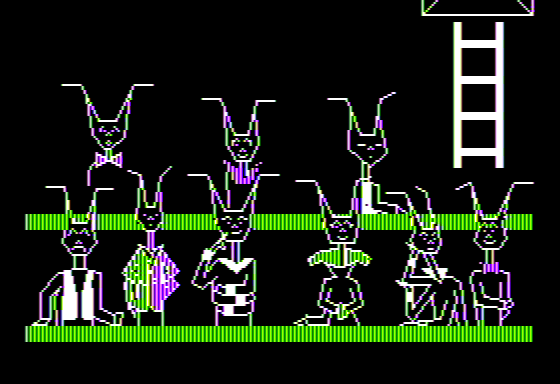
Image

The Apple II has a high-res graphics mode, but it is absolutely bonkers. The main screen is 280x192 or 140x192 depending on how you count: the same 40 bytes per line that we saw on the C64, but each byte has a palette select bit and 7 color bits. That gets interesting because each colored pixel, to a first approximation, has 2 bits describing its color, which in turn means that each byte in the display is specifying three and a half pixels. One of them is not only split between bytes, it has an intervening palette-select bit. The palettes also overlap, so the total usable palette is 6 colors, not 8.

These are some rough constraints. Fortunately, Interplay was full of actual wizards.

Image

One of the other defining features of the classic Apple II display was horrific color fringes and general color noise when not hooked to a monochrome green screen. We see some of that in the text, but only a bit; the graphics end up leaning into it in ways that look like intentional dithering. Beyond this, the Apple II graphics match the C64 graphics quite closely despite being of different resolutions. It's pretty clear they're working off the same designs even though they aren't identical the way the IIgs and ST versions were.

(Notice also the actual mouse cursor. They programmed multiple mouse drivers into this to make sure you could use it with your pre-Macintosh system.)

Before moving back to 16-bit land, there is one other graphic from the 8-bits I want to bring up:

Image

Ennio in the 16-bit versions gave me J. Jonah Jameson vibes for whatever reason. Here in the 8-bit versions he appears to have a fedora and trenchcoat on a hook. I must assume that he dresses up like Humphrey Bogart whenever he's chasing a story here.

And with that, at long last, back to where we started.

The Apple IIgs

On paper, the IIgs should have been amazing. It came out five years before the SNES, but had the same CPU, running slightly faster than the SNES's CPU usually ran on its launch titles, alongside bitmap mode that was close to but strictly superior to the Atari ST's color modes and a custom sound chip that rivaled the Amiga's and was itself also approximately SNES-class. It also had essentially perfect backwards compatibility, with a more reliable and comfortable version of the 8-bit Apple II's wacky graphics modes (keeping the color bleed but making the edges sharper along the way) and a real sharp text mode that could do 40 and 80 columns with equal aplomb and would run all your BASIC programs three times faster:

Image

It landed two years after the earliest Macintoshes did, and its "GS/OS" operating system did its damnedest to give you something approximating the Mac experience on its own hardware, starting from the initial boot screen...

Image

... to the actual Finder itself.

Image

That said, GS/OS didn't land until 1988, two years after Tass Times did. If you look at that finder window, you'll see that the ADVENT.SYSTEM program in the window has a little 8 on the application page. That's indicating that it's an executable written in the format expected by the 8-bit Apple IIs, despite being a fully 16-bit program. A later edition fixed this and made it fully GS/OS native; that's the version that's in Becky's archives. Still, it handles it just fine, with maybe a few wobbles not unlike what you'd get back in the days when you could run DOS games from Windows.

The Finder window here is running in the 4-color 640x200 mode, while the game itself is using the 16-color 320x200 mode. These sound like they're tracking the Atari ST here, but there's an interesting subtlety: these are actually the same mode. A big part of what differentiated advanced displays on these systems was how you went about changing your graphics modes and configurations mid-screen. The systems we've seen so far offer four strategies, and the IIgs brings in a fifth that I haven't seen in any earlier systems:
  • You can just not. This is what the Atari ST does. If you're really insanely clever you can reconfigure things at exactly the right time by deducing where you should be and changing stuff then, but that's basically doing the next technique without any help and with some pretty serious reliability problems.
  • You can have the system tell you when it's time to change things. This is how the C64 works. Its graphics chip lets you set a little timer that goes off when the screen display hits a certain line, so you can set your alarm, change your modes as needed, then set the alarm again, and so on.
  • You can tell the system in advance what to change and when. That's what a Copper list does, on the Amiga. Basically the C64 approach but backwards.
  • The splits are hardcoded options. The mixed graphics/text modes on the 8-bit Apple IIs work like this, with 4 lines of text at the bottom of the screen and the rest graphics. Most illustrated text adventures for that system worked like that; Tass Times is interesting here in part because it uses the whole screen for graphics and manages text completely on its own.
The IIgs approach was to have a little table of 200 entries, one for each line, and each entry in the table specified whether that specific line was a 320x200 16-color line or a 640x200 4-color line, and also which 16-color palette was the one to use for that line from a selection of 16. The full palette was thus 256 colors out of the same 4,096 the Atari ST and Amiga offered; you just could only use 16 at a time. In addition to all that, in the 4-color modes, which 4 colors in the 16-color palette varied in a 4-pixel cycle. I'm pretty sure that's why the background of the Finder window has those vertical lines; it's the same 2-bit color value across the screen, it's just auto-dithering based on the palette rotation.

So.

Given all that, I am doubly unsurprised that Interplay decided to just ignore all that nonsense and provide a near-perfect match of the Atari ST graphics but with a custom text renderer. Even if they could take advantage of the multiple-palette selection, the fact that the command buttons are all on the right edge of the screen would mean that you'd have to keep those colors static on all palettes. It's overall more trouble than it's worth.

Apple internally viewed the IIgs as a threat to its own Macintosh sales and basically strangled the thing in the crib. The only meaningful upgrades it ever got over its whole lifespan were a bit more RAM. The CPU never improved, and even the ST outstripped its graphics capabilities by the end as later models got 32-bit processors and 2D accelerators. It's a pity. The IIgs is a lovely machine on its own terms, but it never got the chance to exist on its own terms.

Echoes of the Future

There's a kind of funny parallel with the mode-switching stuff once we fast-forward to the early 1990s and the 16-bit era of game consoles. I described a lot of the IIgs and capabilities as "SNES-class" up above, but the SNES's advanced graphics capabilities were actually very similar to the Amiga's Copper. It had a feature called "HDMA" that was basically a very slightly less fine-grained Copper list (you could only set them at the per-scanline level) but it got more mileage out of it than the Amiga could because the SNES's later-era graphics chip just had more, and cooler, knobs to spin mid-frame. The Sega Genesis, on the other hand, used hardcoded tables in the Apple IIgs style, supplemented by a C64-like interrupt system for when the tables were insufficient.

A big problem with the IIgs-like table systems is that they're super clean and easy and great if your problem is shaped exactly like the problem they solve, but otherwise you're completely screwed and have no escape. Sega was wise to retain the C64-style back door.

Sirs Not-Appearing-In-This-Update

The two major ports I didn't look at here are, funnily enough, the ones for the only computers to survive the 1990s: the PC and the Macintosh. There's not a lot to say about either, though.

The Mac version has its own graphics set built around being entirely monochrome and high-resolution.

The PC version is from that exceptionally awkward era where games were assumed to be run on computers with CGA cards but which were plugged into television sets, where the graphics distortions would reliably turn into a secondary color palette. It also shipped only as self-booting floppy disks with custom filesystems that DOS couldn't read, so Apple ends up reigning supreme here as the single vendor whose computers could run this game off their damn hard drives. On the flip side, thanks to needing to boot directly into the floppy disk, they developed and shipped their own mouse drivers, because they really, really seemed to have cared about this.

I also feel a need to underline that every single one of these ports came out basically simultaneously; the gap between the first and last release is two months. This isn't a case like Prince of Persia where the ports dribble out over the course of four years. Interplay was absolutely not fucking around here.

Except for that Amiga port. Seriously. The gap there is so vast I'm not 100% sure my disk images aren't damaged somehow.
Post Reply